I’ve been a musician since early childhood. Music has been playing in the background or foreground through all of my developmental stages and in all of my many adventures.
I didn’t plan or predict it, but long before I was educated in counseling, I earned a BFA in jazz guitar and vocal performance–a really practical career choice, right?
But I have no regrets about the time I’ve spent learning music, growing in technique, applying my abilities to worship, and exploring many other genres of music. Not one.
The ability to play, write, and listen to music has amplified joy for me in good times and soothed my broken spirit in tough times. I can’t imagine life any other way.
God put music in my heart from the beginning, and thankfully my parents cultivated the gift. We listened to a wide variety of musical genres at home and attended live performances frequently. They provided music lessons from the age of five all the way through my college years.
Naturally, once I started studying Scripture in my twenties, I began to understand a biblical perspective on the place of music in my life. It became clear that God had fashioned me to be a musician for his own reasons, and not just for my own fulfillment or career ambitions. I have since recognized a calling and responsibility to share music as a way of ministry. All of the gifts we receive from him are intended to be shared with others. I am his servant.
When I later became a therapist, I became curious about how music can be used to augment other therapeutic modalities. I studied a bit about the field of music therapy, learning that it is used quite efficaciously in all kinds of clinical settings—nursing homes, hospitals, and rehabilitation programs.
In my own practice, I have often played recorded songs in session for clients, recommended specific songs for them to listen to on their own, or prescribed a practice of daily listening. This has been especially beneficial for Christians who benefit from singing praise and worship songs to God. It lifts them out of anxiety, despair, and self-obsession. It focuses them on the love and grace of the Lord.
Outside of the therapy room–in churches, parachurch ministries, Bible studies, bars, restaurants, conferences, and classes—I have seen countless times the power of music to quiet confusion and torment in the human soul.
There is a strong biblical precedent for this in the story of David and King Saul. I recommend you review the story yourself in 1 Samuel 16-18, but to summarize:
After Saul was anointed by Samuel and appointed to be Israel’s first king, the Spirit of God would “rush upon” him and move him to prophecy. He also received guidance from God through the prophecies of Samuel and others. But God became displeased with Saul’s patterns of disobedience and presumption and transferred the kingly anointing to David. The Spirit no longer spoke to Saul, and Samuel stepped out of his life.
In spite of these troubling factors, Saul did not quietly step aside to make room for David. He continued to serve as king and commander of the Lord’s armies without the Spirit’s help, and a dark, oppressive spirit would torment him instead.
Saul’s attendants suggested that he find someone who played the harp well to come play for him; perhaps this would help him feel better. One of them suggested “a son of Jesse of Bethlehem,” describing him this way:
“He knows how to play the harp. He is a brave man and a warrior. He speaks well and is a fine-looking man. And the LORD is with him.” (1 Sam. 16:18).
Note this description: musically talented, courageous, proven on the battlefield, articulate, and physically attractive to boot! But this attendant saves the best for last: “The LORD is with him.”
Saul agreed to give it a try and invited David to join his household. When the troubling spirit came upon Saul,
David would take his harp and play. Then relief would come to Saul; he would feel better, and the evil spirit would leave him (1 Sam. 16:23).
This worked pretty well for a time. David’s music served as an effective treatment for acute spiritual attack, but it did not cure or deliver Saul. Soon after David was installed as Saul’s music therapist, David displayed his prowess as a warrior by slaying Goliath and thousands of Philistines. He became as famous as Saul in Israel.
Saul’s torment, fueled by jealousy of David, caused an escalation in his mental and spiritual sickness. As happens with many medications and treatments, after a while the patient develops a tolerance for an intervention and it no longer works as well or as reliably.
Still, we can learn from this story that when individuals are afflicted with a dark, depressive, tormenting mood, sometimes music is the right antidote. Music penetrates directly to the heart, the seat of the emotions. Music can quiet torment and chaos.
This is why I often instruct depressed clients to begin taking daily walks if they are able and put on a playlist of uplifting music. It doesn’t have to have words, necessarily, because music has power in itself. But if the music does include singing, I suggest that the lyrics be Christ-honoring, truthful, edifying, and affirming of God’s love and grace.
Music of this type lifts our heads to the God who saves. It pulls us up from the low place and allows us to glimpse the light that can only be seen from a higher place. It can find its way to the deepest wound, and work like a balm to soothe the ache that resides there.
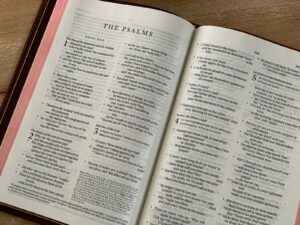
It must be important to God, because he inspired a long songbook, The Psalms, so we always have an abundance of good material.
Music can prophesy, speaking truth faster than any sermon from a preacher. This is why Paul instructs the saints not to get drunk on wine, but to–
“…be filled with the Spirit, speaking to one another with psalms, hymns, and songs from the Spirit. Sing and make music from your heart to the Lord, always giving thanks to God the Father for everything, in the name of our Lord Jesus Christ” (Eph. 5:19-20).
In his letter to the Colossians, Paul wrote,
“Let the message of Christ dwell among you richly as you teach and admonish one another with all wisdom through psalms, hymns, and songs from the Spirit, singing to God with gratitude in your hearts” (v.16).
Of course, our worship of God is about more than just music and singing. It involves receiving his word, repentance, confession, communion, thanksgiving, and celebration. But because music is such a potent delivery system and a catalyst for the Spirit’s work in all of these acts of worship, it is fitting that music be present in our corporate gatherings.
Music is an immensely powerful gift of God. As with all of his good gifts, we need to thank him often for music and appreciate how it works in the building of our faith. We need to sing to one another and in harmony with one another, often. The Holy Spirit delights to speak to us in song and uses music as a tool in our sanctification.