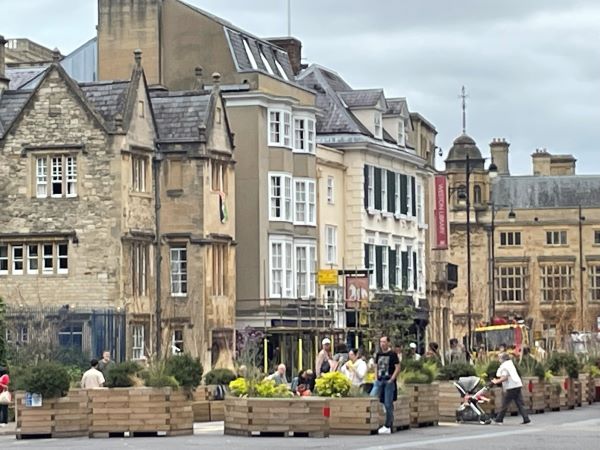
Last week I had the immense pleasure of visiting Oxford, England with a group of 14 writers. As we basked in the mysterious essence of a thousand years of history, we were transformed and in awe of God’s sovereignty and beauty.
Oxford’s history is marked by its share of cruel scars. This happens wherever religious or political tyranny takes hold, and Oxford has not been immune. Many religious wars and coups occurred inside and outside the city gates of Oxford. The blood of Protestant martyrs was spilled. At other times, Catholics and Jews were excluded, shunned, and expelled, or killed. Women were excluded from the academic halls of Oxford University until 1980.
Acknowledging this reality, we nevertheless profoundly experienced that the “City of Dreaming Spires” has mystery, magic, ancient and modern beauty, and fascinating culture to celebrate.
We walked cobbled streets lined with massive, ornately decorated stone buildings unchanged from when they were erected so many centuries ago. We heard church bells ushering believers to worship at Christ Church, the same bells Lewis Carroll must have heard as he was penning his masterpiece, Alice in Wonderland.
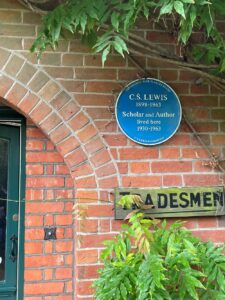
 We visited the humble home of C.S. Lewis and his brother Warren, where we could almost smell the pipe ashes ground into the carpets and hear the typewriter clacking as Lewis, nicknamed “Jack,” dictated and Warren typed his letters and essays. We stood quietly at his simple gravestone in the small graveyard behind his church and thanked him for his abundant contribution to our collective imaginations and theological understandings.

We quietly meandered along Addison’s walk adjacent to Magdalen College, where Lewis, Tolkien, and Hugo Dyson, three of the Inklings, discussed myth and reason, imagination and faith. As a result of these conversations, Lewis rejected atheism and surrendered his heart to Jesus Christ the King.
We spent unhurried time at the cemetery where Tolkien was buried with his wife Edith.
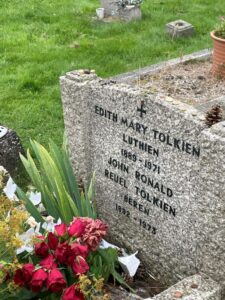
They lived out a marvelous, improbable love story that inspired some of Tolkien’s stories. Our leader, Brae, prompted us to consider our love stories with the Lord.
Mine arose from my spirit in a poem:
A Love Story at the Grave of J.R.R. Tolkien and his Wife Edith
My Savior, my Beloved, you found me in my wildness,
Apprehended my wandering heart.
You saw that I lived as one with her own plan,
An unguided and sometimes misguided destiny
That would someday end in a pit.
You took my hand and began leading me to places and moments of discovery.
You didn’t force it, but let it unfold
Like the best of storytellers weaves a tale,
And it has been a page-turner ever since–
Part glorious, sparkling with worship and praise,
Part quiet domesticity and contentment,
Part grand adventure,
Sometimes by grace predictable,
And other times—also by grace—wholly unpredictable,
Marked by mysteries that kept my soul full of wonder and gratitude
Thank you for taking me into this indescribable, unique,
Exquisitely wonderful love story with you.
Only you and I know it in full (yet you know more),
In color and detail, all that is both hidden and unhidden to the world
This is the secret place of serenity and completeness
Where I abide with you.
This is our home, furnished in comfort and beauty
A Bible open, a cup of tea on the sill,
The wildflowers in a vase,
The sound of quietness,
The approach and summons of new inspiration in the mild morning light.
This is how I want to live with you each day
Until I lay my head upon your ever-beating heart in the
New mansion you have been building in another world,
Far away, beyond the sleep of death
Where I awaken to live eternally in your light and love.
–Ruth E. Stitt, August 6, 2024
There is much more to tell. But that will be enough for now.
My impulse and mission is always to share with others the many good things God shares with me. I pray this offers you encouragement, inspiration, and meaning in your unique walk with him.