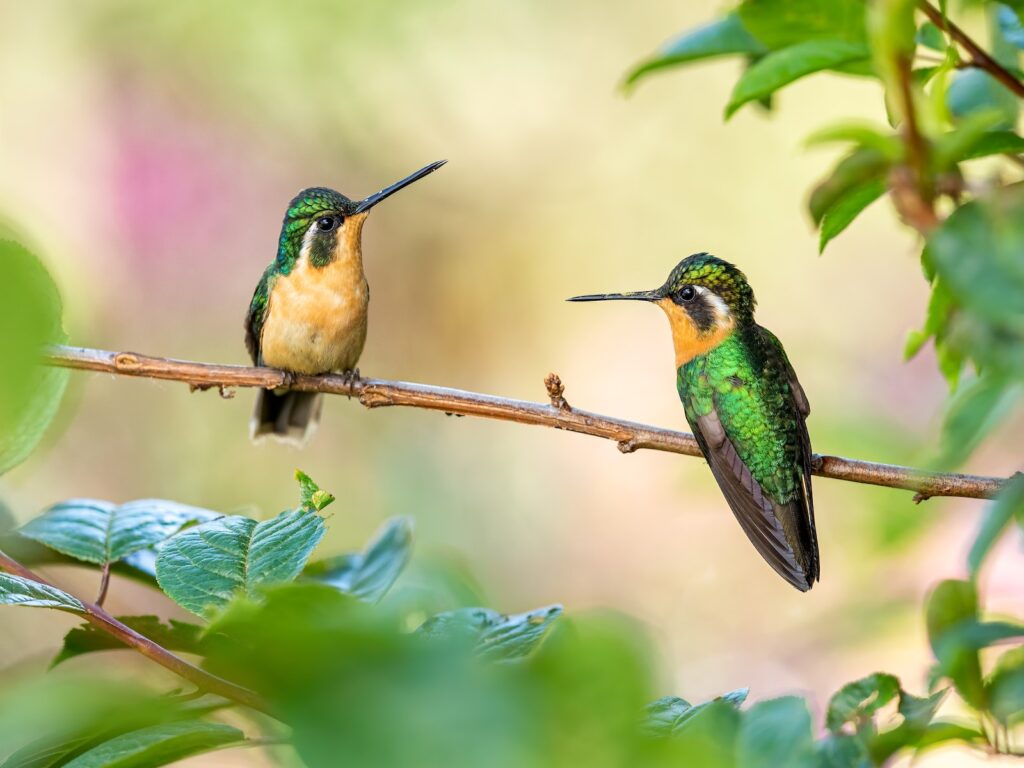
This year I have gone through at least ten pounds of sugar keeping my two hummingbird feeders full of sticky sugar water. Recently they’re in need of refilling every other day.
This means that we must have dozens of hummingbirds accessing my two quart-size feeders, when we are observing them and especially when we are not.
The other day I commented to a friend that keeping these feeders full is probably not the best use of my time, effort, or money. Have you noticed the escalating price of refined sugar these days?
When I’m not busy feeding hummingbirds, I’ve been intermittently reading a delightful and brilliant book called Big Magic: Creative Living Beyond Fear. It is a non-fiction book by the novelist Elizabeth Gilbert about the love of writing and other forms of creativity.
Gilbert speaks of creative inspiration as something mystical, as a kind of spirit that drifts around in the atmosphere looking for willing human partners who will receive it and make something with it.
To illustrate with metaphor, she cites an environmental biology professor who challenges her students to consider the natural world as an entity with whom humans have a living, mutually energizing relationship. She muses that we all say we love nature, but do we believe that nature loves us back?
I embraced this nature metaphor immediately and will apply it gladly to my work as a writer. If I see myself as a person who has an ongoing, intimate, reciprocal relationship with creative inspiration, I will find much more joy in the work. Writing and other creative work can involve lots of pain and suffering, but pain and suffering is not required. Sometimes inspiration comes with love, joy, excitement, or awe.
As I pondered these ideas, I looked out and realized that the hummingbird feeders were empty yet again. There were no flittering birds in view, and that made me sad.
I realize that these hundreds of birds working so hard to survive will find other food sources if I don’t provide for them. But you know what? Hummingbirds require a lot of nectar to stay alive. I found this on a nature website:
“Hummingbirds have a very high metabolism and must eat all day long just to survive. They consume about half their body weight in bugs and nectar, feeding every 10-15 minutes and visiting 1,000-2,000 flowers throughout the day.” *
I have a few flowers around the property that have survived the Texas heat wave, and I watch the hummingbirds drink from them sometimes.
But I believe it makes a difference to them that I keeping mixing up this nectar in abundance and placing it where their needle-like beaks can sip on it. We have established a reciprocal relationship. They find sustenance and can live to fly another day. I get to enjoy watching them as my gift.
Because Scripture comes to life, and live goes to Scripture, my mind goes to Noah in Genesis 8.
God warned Noah that constant torrential rainfall would flood the earth for 40 days and destroy every form of life. Only those animals, birds, plants and humans aboard the huge ark Noah was to build would survive to repopulate the earth.
As Noah was building and then requisitioning supplies for the boat, he had to consider all of the calorie needs for at least two each of species of animal life. What a logistical feat, managing resources to keep everyone and everything alive for an indeterminate amount of time!
When at last the rain ceased and waters could subside and evaporate, the ark landed atop Mt. Ararat. Noah sent out a raven to see what it would do. The raven flew back and forth aimlessly, returning to the ark, because he could see that Noah’s boat was still the only source of food.
Next, Noah sent out a dove,
“to see if the water had receded from the surface of the ground. But the dove could find nowhere to perch because there was water over all the surface of the earth.” (v.8-9).
There were no trees, no grass, no rocky perches where it could rest. No life, and no bird feeders. Then we view this poignant virtual snapshot of Noah’s relationship with this gentle, vulnerable creature:
“Noah reached out his hand and took the dove and brought it back to himself in the ark.” (v.9)
After seven more days, Noah sent the dove out again, and it returned with an olive leaf in its beak. Again, the dove rejoined the creatures on the boat, but with a sign that things were about to change.
Another seven days elapsed, and Noah sent his dove friend out again. This time the dove did not return. Clearly it had found renewed life and the ability to feed and sustain itself. I imagine Noah may have had mixed feelings about this. He probably was relieved that restoration of life was occurring beyond the bounds of the ark, and they’d soon be freed from confinement. But perhaps he was also a bit sad to know he was unlikely to partner with this dove again.
This is how things were supposed to be. This is how things were before the fall. God gave Adam and Eve dominion over all of nature. It was a relationship of loving authority, responsibility and genuine caring for God’s creation. Before the curse, creation loved them back unreservedly. After the curse, there was enmity. Thorns, drought, predators, prey.
We still have a troubled relationship with nature, until Christ restores all things to perfection. But we can still individually and collectively love and nurture the natural world as we wait.
So, as I measure and mix my batches of sugar water the umpteenth time for the gorgeous hummingbirds that come our way, I celebrate that they do come. They come to see if I’ve thought of them and provided for them.
Maybe as they sip on the nectar, they are aware, as I am, that I do love them and have made them a part of my life. When they join with me in this exchange, that is sufficient evidence that they are loving me back.
* https://www.adirondackcouncil.org/page/blog-139/news/10-facts-about-hummingbirds–and-other-interesting-tidbits-1101.html