
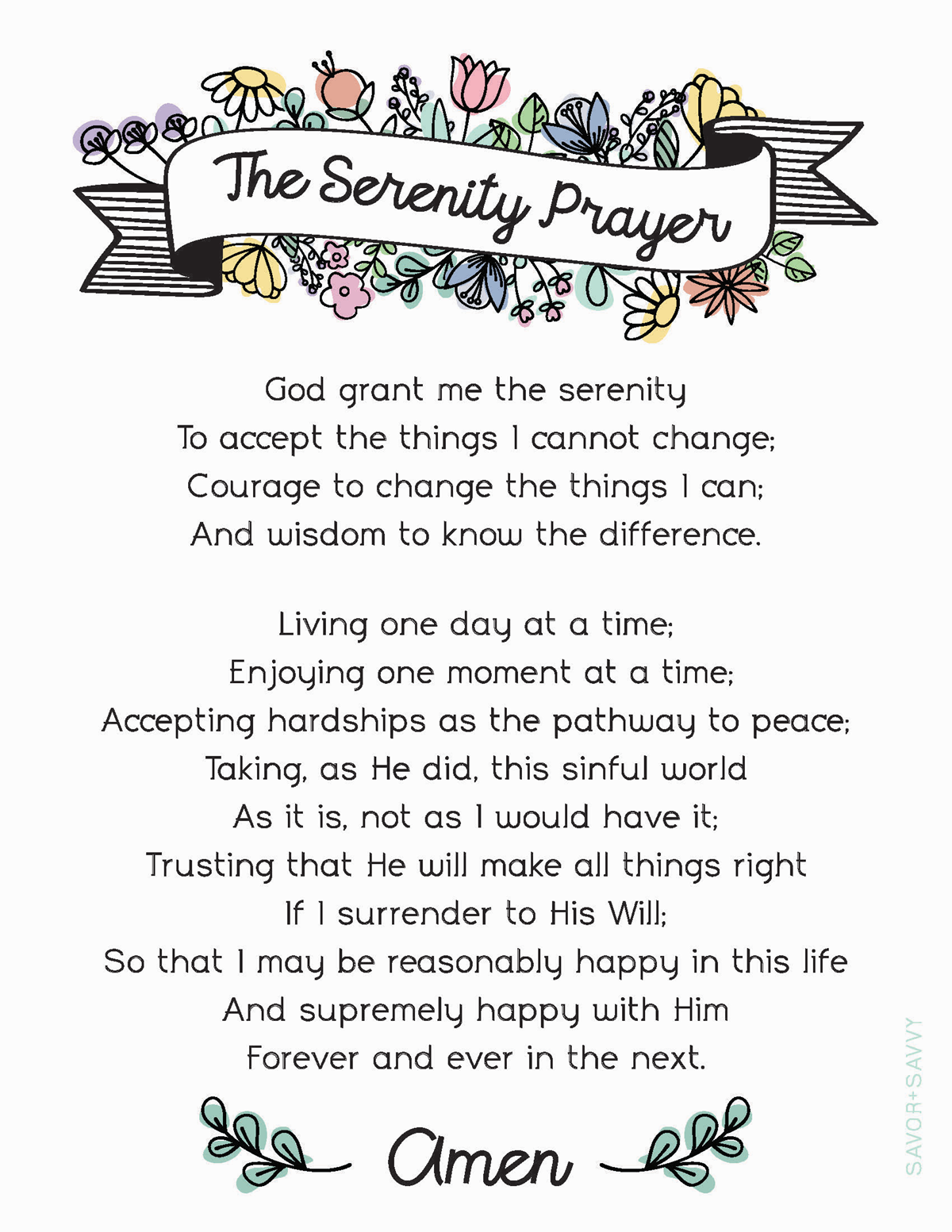
Anyone who has spent time in rooms where 12-Step Recovery is happening is well familiar with the first stanza of the Serenity Prayer.
Christ-centered 12-Step programs like Celebrate Recovery recite the full poem penned by the theologian Reinhold Niebuhr (1892-1971), but traditional AA and Al-Anon groups typically leave out the remainder, largely because the poem refers to a particular Higher Power, the Lord and Savior, Jesus Christ. Participants in AA are encouraged to surrender to a “god of your understanding.” The program welcomes those in need of recovery, of any religion or none, however they identify their higher power.
Either way, in my opinion, the Serenity Prayer is one of the finest, wisest pieces of writing in existence, outside of the Bible. The entire prayer, not just the first four lines.
The familiar first stanza is succinctly brilliant: seeking serenity to accept what is not ours to change, seeking courage to change circumstances that we do have power to change, and, as we navigate tests, trials, victories, and tragedies, gaining wisdom to discern the difference. These four lines have been sanity-saving many times for me, and for countless other people.
But today I want to celebrate the brilliance of the rest of the poem, and its applicability to our walk with the Lord in a very troubled world.
Neibuhr expresses the beauty and wisdom of living each day as it comes, one moment at the time. I fully embrace this idea of living in the present, not obsessing about the past or worrying about the future.
But the next part is what prompted me to write about the prayer.
In our time, the idea of accepting hardships as the pathway to peace is utterly countercultural. Instead of accepting hardships at all, younger generations especially are taught to scream about them, post their grievances on social media, or start a revolution.
The Apostle James wrote the well-known verses,
Consider it pure joy, my brothers and sisters, whenever you face trials of many kinds, because you know that the testing of your faith produces perseverance. Let perseverance finish its work so that you may be mature and complete, not lacking anything. (James 1:2-4).
Is this not a pathway of peace? The ability to withstand difficult circumstances and allow them to grow us, mature us, sanctify us, train us to closely follow in the steps of the Prince of Peace? I think so.
The next lines are my favorite at the moment.
Taking as He did, this sinful world as it is, not as I would have it;
Trusting that He will make all things right
if I surrender to His Will
Here the poet portrays Jesus as a realist. He saw and heard his Father’s perspective and plan for his creation. Evidently, it was not the Father’s mission for Jesus to fix the broken world on his first visit, but to show the world the reality of the coming kingdom of God.
His commandment was that his disciples would, with his authority, do greater works (John 14:12): go, preach the gospel of the kingdom, heal the sick, cast out demons, baptize, and make more disciples. (Matt 28:18-19; Mark 16:15-18).
To do this, we must take the world as we find it. Only if we see thing as they are will we consistently go around doing good, as Jesus did (Acts 10:38).
We are not entitled to a different world than the one we’ve got. This is the very damaged world in which he wants us to make a difference by giving of what we have freely received from him.
He holds the future and brings the outcome. We only participate on the harvest crew. Or not.
As the poem concludes, it holds out the promise, consistent with Scripture,
That I may be reasonably happy in this life
and supremely happy with Him
Forever in the next. Amen.
When we find ourselves murmuring and complaining and judging the ungodliness of the world, this poem is a strong reminder that this world will never be truly restored until the Creator determines it is time. So, we must dwell in reality.
It is foolishness to go around constantly being disappointed with people, even those who persecute Christians or are wicked in other ways. This is the reality of the human situation, just as it was when Paul wrote these words to his protégé Timothy:
…everyone who wants to live a godly life in Christ Jesus will be persecuted, while evildoers and impostors will go from bad to worse, deceiving and being deceived. But as for you, continue in what you have learned and have become convinced of… (2 Tim. 3:12-14).
So the question is, what have we learned and become convinced of? This is my answer:
That the word of God is trustworthy and sufficient to guide me through life.
That God is good at all times, whether or not I understand what he is doing.
That God’s plan of redemption will not fail.
That there is a bright, eternal future awaiting me and all those who have put their trust in the only one who can ever save.
That if I remain devoted to him, he will help me lead others to him, and my life will be full of meaning and purpose.
That he will make everything right in the end.
That in the meantime, I can be reasonably happy, and that is happy enough for now.